Computational mechanics for many-body contact, friction, and fracture
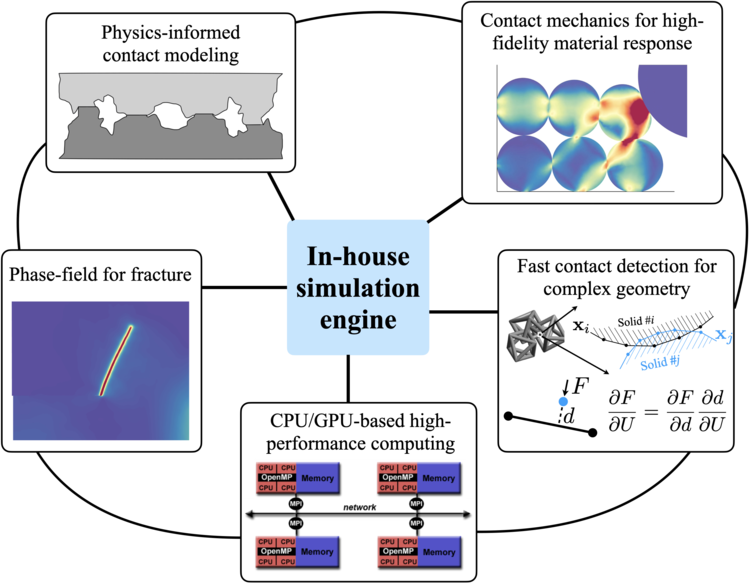
We seek to develop state-of-the-art computational mechanics techniques for modeling the nonlinear behaviors of complex material/structure systems involving multi-body contact, friction, and fracture. Granular media is a model example in this regard. These techniques allow us to access each unit's kinetic and kinematic information, which is essential for developing a simple yet effective method for large-scale applications. Current interests lie in incorporating tribological physics and dynamic fracture mechanics into our in-house simulation engine. Tools we use for developments include, but are not limited to, variational phase-field approach to fracture, contact mechanics, and CPU/GPU parallel computing. Lastly, we support the constitutive modeling component through our advanced material characterization and testing techniques.
Optical sensing for dynamic fracture characterization
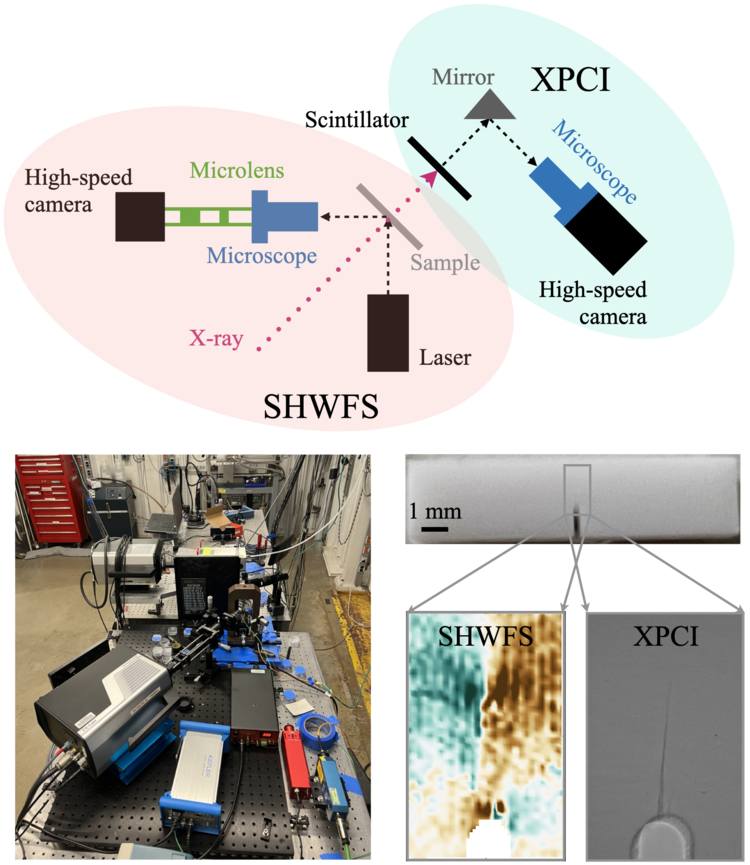
Brittle materials such as ceramics and glass find applications in many industries, including construction, energy, and consumer electronics. Characterizing and understanding the fracture properties of these brittle materials is essential for safety-critical applications. However, their high stiffness and low toughness make investigations using conventional image-based techniques (e.g., Digital Image Correlation) challenging, especially when moving beyond quasistatic scenarios. We seek to overcome this challenge by adapting and developing high-speed optical sensing techniques that are compact in space yet effective with high spatial-temporal resolutions. Current research focuses on integrating Shack-Hartmann wavefront sensing (SHWFS) with X-ray phase-contrast imaging (XPCI) to enable time-resolved, in situ, multimodal fracture characterization across a wide range of brittle materials, from glass and ceramics, to polymers. In the long term, we wish to expand our research effort to additively manufactured materials/parts, providing fundamental insights into defect-modulated fracture processes.
Contact, friction, and fracture by design for "dynamic" structures and materials
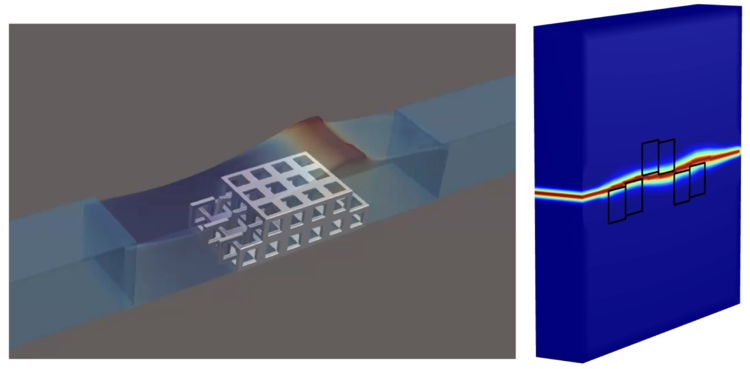
We seek to harness the basic (yet often nonlinear) mechanics of (many-body) contact, friction, and fracture to design—with the help of AI and through the lens of geometry—"dynamic" materials and structures that change their properties by interacting with their surrounding environment. Currently, we are particularly interested in stimuli-responsive structures where the enabling stimulus aligns with the intended application, with the former stemming from extreme natural hazards, such as wildfire (i.e., heat), storm surge (i.e., hydrodynamics), and earthquake (i.e., mechanical vibration). The central principle guiding our design is targeting maximized desired outcome with minimized required input, and, by deploying these “dynamic” structures, we hope to enhance the resilience of our built environment in its interaction with the natural environment in a more sustainable way.
Information decomposition and extraction across scales for granular rheology
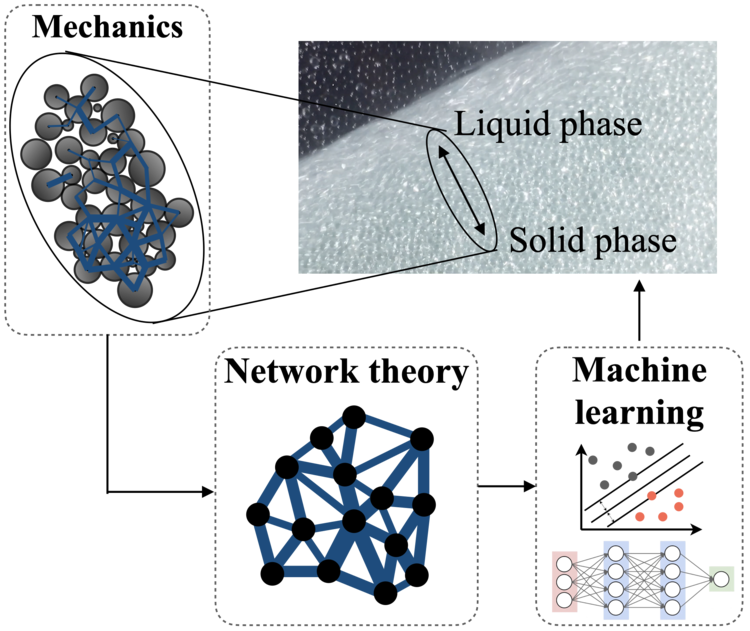
Heterogeneous granular flows are ubiquitous in nature and industry, from landslides to pharmaceutical engineering, and even additive manufacturing. At the continuum scale, it is well known that they exhibit collisional, dense, and creep regimes, which can coexist in space. Accurately predicting and controlling such complex phenomena has many applications in both mitigating natural hazards and optimizing industrial processes. However, it still remains a challenge to establish a robust granular rheology model with a unified microphysical foundation, due to the lack of understanding of the internal structure variation across different regimes and its interaction with the boundary. To address this challenge, we combine our in-house simulation engine with knowledge from network theory and machine learning to identify the minimal set of particle-scale ingredients that are most relevant to spatial phase transition observed at the macroscopic scale (TLDR: what to keep and what to throw away?). Our long-term goal is to build a predictive and practical macroscopic theory with a unified microscopic interpretation.